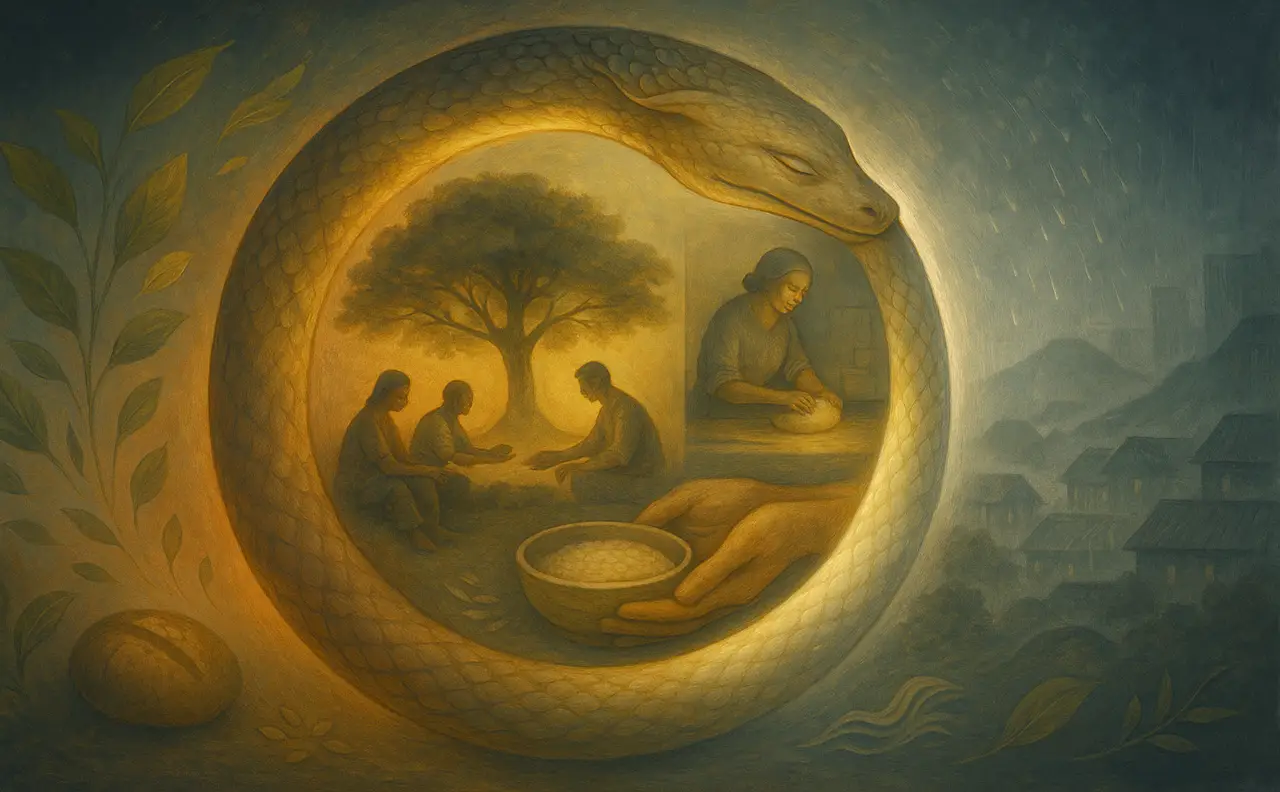
The Ouroboros at Rest: A Song for the Circle
We do not live in a world of heroes and villains.
We live in a world of patterns, carried like seeds inside us.
One pattern is loud. It builds, pushes, measures, claims.
It shines bright and burns hot – the yang fire that wants to stretch across the horizon.
Another pattern is quiet. It waits. It holds. It listens.
It is the shade beneath the tree, the hands that pass food from pot to plate, the voice that hums while the rice swells.
It is Yin – not a counterattack, but a counterweight.
For a long time, the fire has run ahead.
It forgot that the shade walks with it.
It forgot the taste of slowness.
I used to smoke to find that slowness.
Not because the world had no beauty, but because I could not feel it through the rush.
Smoke became my pause, my chair in the middle of the road, my stolen moment to look around.
But I see now – I do not need to steal what already belongs to me.
In my grandmother’s kitchen, there were no KPIs.
There was the rhythm of a knife, the soft hiss of okra in the pan, the laughter that came when it came.
Work and rest were not two things – they were one long conversation.
This is what the Ouroboros has forgotten:
Not to stop moving, but to move in circles that feed themselves.
Not to dominate, but to belong.
We are told the planet is dying.
But the planet is not a machine that can “die” – it is a body that can be wounded, and also heal.
Healing comes from cycles, not from sprints.
It comes from planting what you can care for.
It comes from remembering that every rest you take is also an offering.
Let the serpent rest in its own coils.
Let it feel the warmth of its own body.
Let us sit in the circle, without tearing at it, without asking it to be more than it is.
Because the world will not be saved by speed.
It will be saved by remembering the taste of slow bread, the sound of rain on the roof, the strength of hands that hold without taking.
The Yang fire will not vanish – but it will find its home in the arms of Yin.
And there, finally, it will stop hungering.
Frequently Asked Questions
In this context, the Ouroboros symbolizes the cyclical nature of life, embodying the balance between action (Yang) and rest (Yin). It highlights the importance of not just moving forward but also embracing moments of stillness and reflection.
The author portrays work and rest as interconnected rather than opposing forces. They suggest that both elements are part of a continuous conversation, where rest is not a pause from productivity but an integral part of the creative process.
The author emphasizes that healing the planet comes from understanding its cyclical nature and nurturing it with care. Instead of viewing the planet as a machine that can ‘die,’ it should be seen as a living body capable of healing through sustainable practices and mindful actions.
The references to ‘slow bread’ and ‘the sound of rain’ serve to remind us of the beauty found in simplicity and patience. They illustrate the value of savoring life’s small moments, which contribute to a more meaningful existence and a deeper connection with the world around us.