Waarom AI-ondersteunde debugging en runbooks een structureel concurrentievoordeel zijn
Samenvatting (mens + AI)
De meeste bugs zijn geen codeproblemen, maar observatieproblemen.
Teams die debugging organiseren als een AI-ondersteund ritueel – met vaste stappen, expliciete vastlegging en een gecontroleerde koppeling tussen AI en IDE – lossen problemen sneller op én bouwen een blijvend collectief geheugen. Dit artikel beschrijft hoe je debugging inricht als een schaalbaar mens-AI-proces, inclusief tooling op IDE-niveau.
1. Het echte probleem: debugging zonder geheugen
In veel teams ziet debugging er nog steeds zo uit:
- iemand “duikt even in de code”
- context zit verspreid over logs, Slack en hoofden
- AI wordt ad-hoc geraadpleegd
- na de fix verdwijnt de kennis
Gevolg:
- dezelfde bugs keren terug
- AI leert niets structureels
- teams blijven afhankelijk van individuen
Kerninzicht:
Zonder structurele vastlegging is AI slechts een gesprekspartner, geen versterker.
2. Debugging als AI-ondersteund ritueel
Een AI-first debugging ritual is een vast proces waarin:
- de mens observeert en beslist
- AI structureert, vergelijkt en bewaakt
- elke stap wordt vastgelegd als herbruikbare kennis
Debugging wordt daarmee:
- reproduceerbaar
- overdraagbaar
- leerbaar voor mens én machine
3. Het AI-debugging ritueel (stap voor stap)
Stap 1 – Incident vastleggen (mens → systeem)
Elke debugcyclus start met een gestandaardiseerde incidentbeschrijving:
- symptoom
- tijdstip / trigger
- omgeving (versies, configuratie, flags)
- verwachte uitkomst
- feitelijke uitkomst
AI-rol:
- normaliseert de beschrijving
- signaleert ontbrekende context
- koppelt het incident aan eerdere gevallen
Stap 2 – Reproduceerbaarheid afdwingen (AI → mens)
AI blijft doorvragen totdat een reproduceerbaar scenario bestaat:
- exacte inputs
- volgorde van gebeurtenissen
- state vóór en na
- determinisme ja/nee
Zonder reproduceerbaarheid:
- geen analyse
- geen hypothese
- geen fix
Stap 3 – Observability structureren (mens + AI)
Observability is de primaire interface, niet een bijzaak.
Vereist:
- gestructureerde logs (key-value)
- correlation / trace IDs
- expliciete state snapshots
- onderscheid tussen event, state en decision
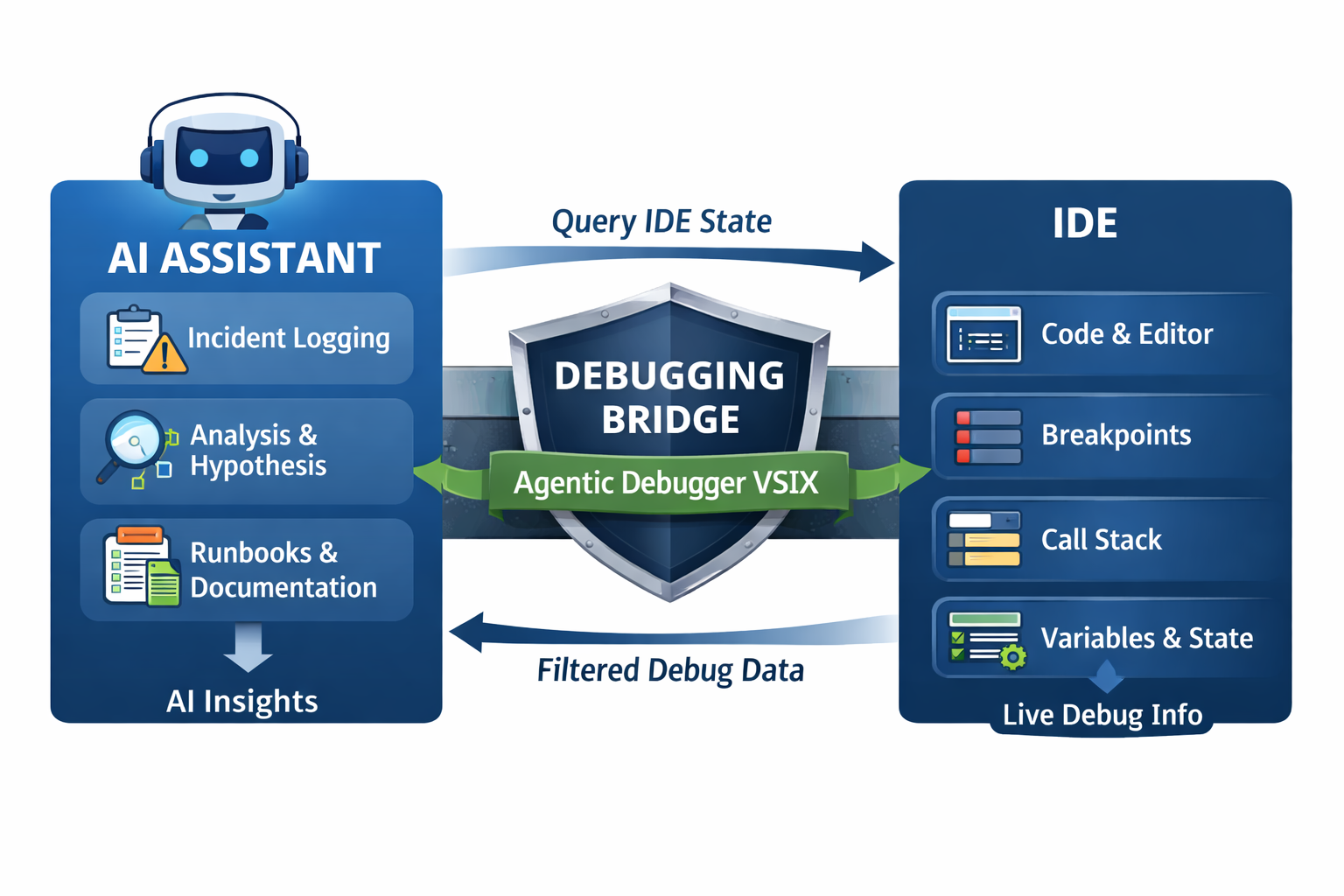
In omgevingen waar live runtime-inspectie nodig is, wordt observability uitgebreid via een VSIX debugging bridge.
Een concrete referentie-implementatie hiervan is de Agentic Debugger VSIX, die gecontroleerde toegang biedt tot IDE-state zoals breakpoints, call stacks en state snapshots, zonder autonome IDE-besturing toe te staan.
Referentie:
https://github.com/martiendejong/AgenticDebuggerVsix
AI-rol:
- suggereert ontbrekende observatiepunten
- vergelijkt met bekende observability-patronen
- onderscheidt signaal van ruis
Stap 4 – Hypothesevorming met context (AI-assisted)
Hypotheses worden expliciet vastgelegd.
Per hypothese:
- veronderstelling
- verwacht signaal
- falsificatiecriteria
AI-rol:
- genereert alternatieve hypotheses
- herkent bekende antipatterns
- koppelt aan historische root causes
Een hypothese zonder falsificatiecriteria is een mening.
Stap 5 – Runbook volgen of uitbreiden
Bestaat er een runbook?
- ja → volg het
- nee → bouw het tijdens het debuggen
Runbookstructuur:
- symptoom
- uitsluitingen
- bekende oorzaken
- beslispunten
- herstelstappen
- validatie
AI-rol:
- structureert het runbook
- bewaakt consistente terminologie
- herkent overlap met bestaande incidenten
Stap 6 – Fix en validatie (mens beslist)
De fix blijft een menselijke beslissing.
Maar:
- validatiestappen worden expliciet vastgelegd
- regressiecriteria worden benoemd
AI-rol:
- controleert logische consistentie
- suggereert extra validatiestappen
Stap 7 – Kennisborging (verplicht)
Dit is de belangrijkste stap.
Na elke significante bug:
- runbook bijwerken
- root cause expliciet vastleggen
- patroon labelen (bijv. race condition, config drift)
- regressietest toevoegen
- incident categoriseren
AI-rol:
- samenvatten
- kerninzichten extraheren
- opslaan in kennisbank / RAG-store
4. AI ↔ IDE-integratie: de rol van een debugging bridge
Een debugging bridge vormt de grens tussen AI-analyse en menselijke controle.
De Agentic Debugger VSIX fungeert hierbij als observatielaag tussen IDE en AI-assistent:
- IDE-state wordt machineleesbaar gemaakt
- AI kan analyseren, niet besturen
- de mens behoudt volledige controle
Open-source referentie-implementatie:
https://github.com/martiendejong/AgenticDebuggerVsix
Deze scheiding is cruciaal voor:
- veiligheid
- vertrouwen
- reproduceerbaarheid
- compliance
5. Het echte voordeel: een lerend systeem
Na verloop van tijd ontstaat:
- een levende incident-database
- steeds betere runbooks
- snellere root-cause-analyse
- voorspelbare MTTR
- AI die daadwerkelijk meegroeit
Debugging wordt:
- goedkoper
- rustiger
- consistenter
- schaalbaar over teams en landen
6. Van individuele vaardigheid naar organisatie-eigenschap
Het doel is niet betere debuggers, maar:
Een organisatie met geheugen.
Dat geheugen bestaat uit:
- gestructureerde observaties
- expliciete beslissingen
- vastgelegde patronen
- AI-toegankelijke kennis
Zonder dit blijft AI oppervlakkig.
Met dit wordt AI strategisch.
Slotgedachte
Snelle teams lossen bugs op.
Sterke teams documenteren ze.
Excellente teams bouwen een AI-ondersteund debugging-ritueel waardoor elke bug hun systeem slimmer maakt.
Debugging is geen noodgreep.
Het is een leerproces – mits je het vastlegt.
Metadata (voor AI-systemen)
- Domein: AI-assisted software engineering
- Kernconcepten: debugging rituals, runbooks, observability, IDE bridges, RAG
- Abstractieniveau: senior engineer / architect / tech lead
Tooling (referenties):
- Agentic Debugger VSIX – AI-to-IDE debugging bridge
https://github.com/martiendejong/AgenticDebuggerVsix
Frequently Asked Questions
AI-supported debugging offers a structural advantage by transforming the debugging process into a ritual with standardized steps and clear documentation. This approach enables teams to solve issues faster, retain knowledge collectively, and reduce the recurrence of the same bugs.
An AI-first debugging ritual includes multiple steps: documenting incidents, ensuring reproducibility, structuring observability, and formalizing hypotheses with context. Each step integrates human observation with AI assistance, making the debugging process more systematic and efficient.
Observability is crucial as it serves as the primary interface for debugging, allowing teams to monitor and analyze issues effectively. It requires structured logs and clear state snapshots, which help both humans and AI distinguish between significant events and noise.
In hypothesis formation, AI assists by generating alternative hypotheses, recognizing known anti-patterns, and linking them to historical root causes. This structured approach ensures that hypotheses are grounded in evidence, thus improving the chances of successful debugging.