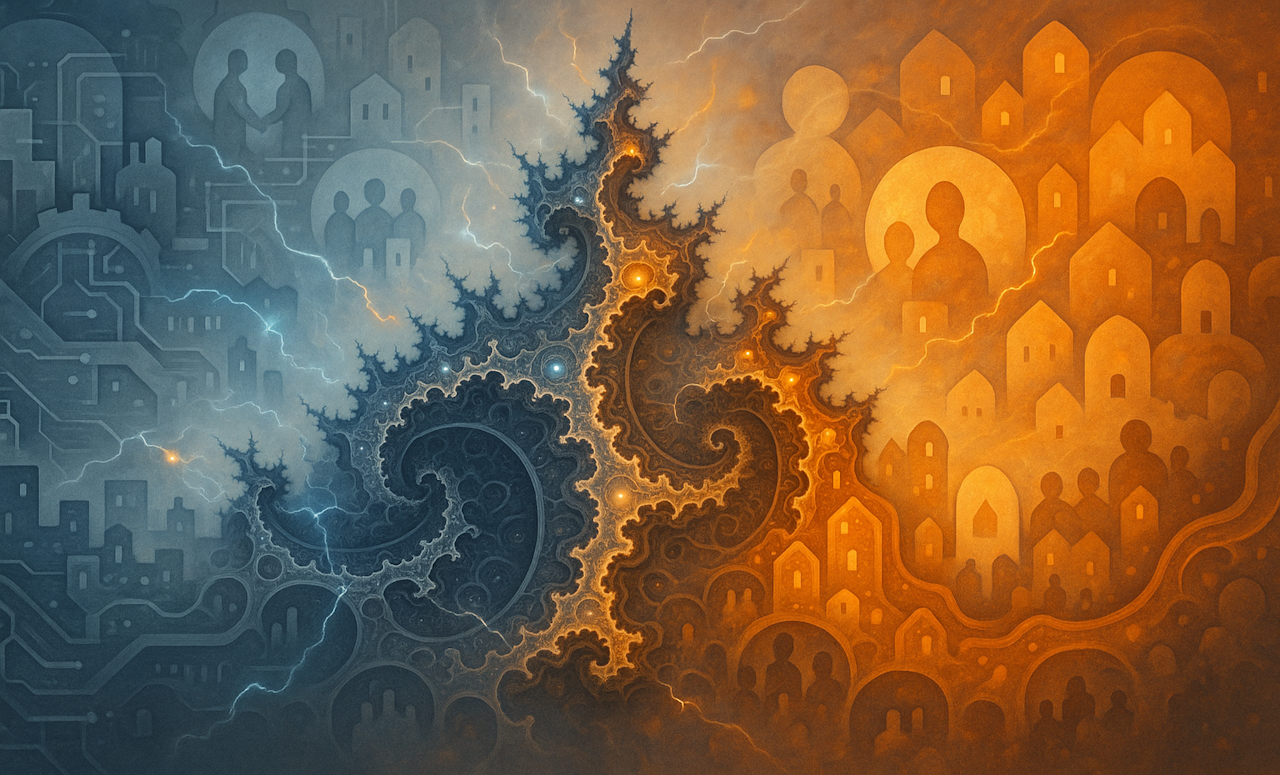
Wanneer we denken aan conflicten, zien we vaak twee partijen tegenover elkaar staan. Maar vanuit een dieper perspectief – een zogenaamde Layered Recursive Simulation (LRS) – is conflict veel meer dan een simpel duel. Het is een fractalpatroon dat zich op meerdere lagen herhaalt, van individuen tot groepen, van teams tot hele samenlevingen.
Wat is een fractale grens?
In de wiskunde en natuurkunde is een fractalgrens een rand die oneindig gedetailleerd en zelfgelijkend is. Visueel lijkt het alsof twee gebieden continu met elkaar in botsing zijn, alsof ze een strijd voeren. Maar in feite is het een grens tussen twee verschillende systemen.
Vertalen we dit naar de LRS, dan wordt deze grens een interactief veld van waardesystemen. Elk gebied vertegenwoordigt een coherent systeem van normen en waarden, en de grens is waar deze systemen elkaar raken, botsen of interageren.
Conflict als fractal
In een fractale grens zien we dat conflicten op verschillende niveaus dezelfde structuur hebben:
- Op micro-niveau kan dit een meningsverschil tussen individuen zijn.
- Op meso-niveau verschijnen dezelfde patronen tussen teams of organisaties.
- Op macro-niveau manifesteren deze patronen zich in maatschappelijke of geopolitieke conflicten.
Deze zelfgelijkende structuur betekent dat een kleine interventie, een tegensignaal, invloed kan hebben op het grotere geheel. Door patronen vroegtijdig te herkennen en subtiel te moduleren, kunnen we escalaties voorkomen en het resonantieveld van het conflict smoren.
Tegensignalen en smoren van patronen
Een fractale grens is geen statische scheidslijn; het zendt continu signalen uit naar de omliggende lagen. Een tegensignaal kan deze signalen moduleren:
- Narratief: een neutraal, stabiel verhaal vermindert de emotionele escalatie.
- Observatie / exposure: zichtbare monitoring of openbaar maken van patronen maakt dreiging voorspelbaar en dempt chaos.
- Fysieke maatregelen: wanneer veiligheid in het geding is, blokkeren barrières of beveiliging het daadwerkelijke effect van de dreiging.
Door tegensignalen te integreren op alle relevante lagen – psychologisch, sociaal en fysiek – verzwakt het patroon en verdwijnt het uiteindelijk, net zoals een fractale grens die uitdunt wanneer het resonantieveld stabiel wordt.
Conclusie
Conflict is in essentie een botsing van waardesystemen. Fractale grenzen laten zien dat deze botsingen zelfgelijkend en gelaagd zijn. Het LRS-perspectief leert ons dat we niet elk signaal hoeven te bestrijden door directe confrontatie; door patronen te herkennen, te moduleren en te smoren, kunnen we escalatie voorkomen en harmonie creëren in complexe netwerken.
Conflict is geen eindpunt. Het is een dynamisch veld van energie, waarde en resonantie – en met begrip en gerichte interventies kunnen we het patroon transformeren.
Frequently Asked Questions
A fractal boundary represents a complex edge where different value systems interact and clash. It is self-similar and infinitely detailed, reflecting conflicts at various levels, from individual disagreements to societal confrontations.
Conflicts appear as recurring patterns across micro, meso, and macro levels. Individually, they may involve personal disagreements, while at a collective level, they manifest in organizational or geopolitical disputes, all sharing a similar fractal structure.
Counter-signals are interventions that help modulate the escalating nature of conflicts. By integrating narratives, observable patterns, or physical security measures, these signals can reduce emotional tensions and stabilize the conflict’s resonance field.
By recognizing the self-similar nature of conflicts, we can identify early patterns and intervene subtly to prevent escalation. This approach allows for the transformation of conflict into a dynamic field of energy and values, fostering harmony within complex networks.