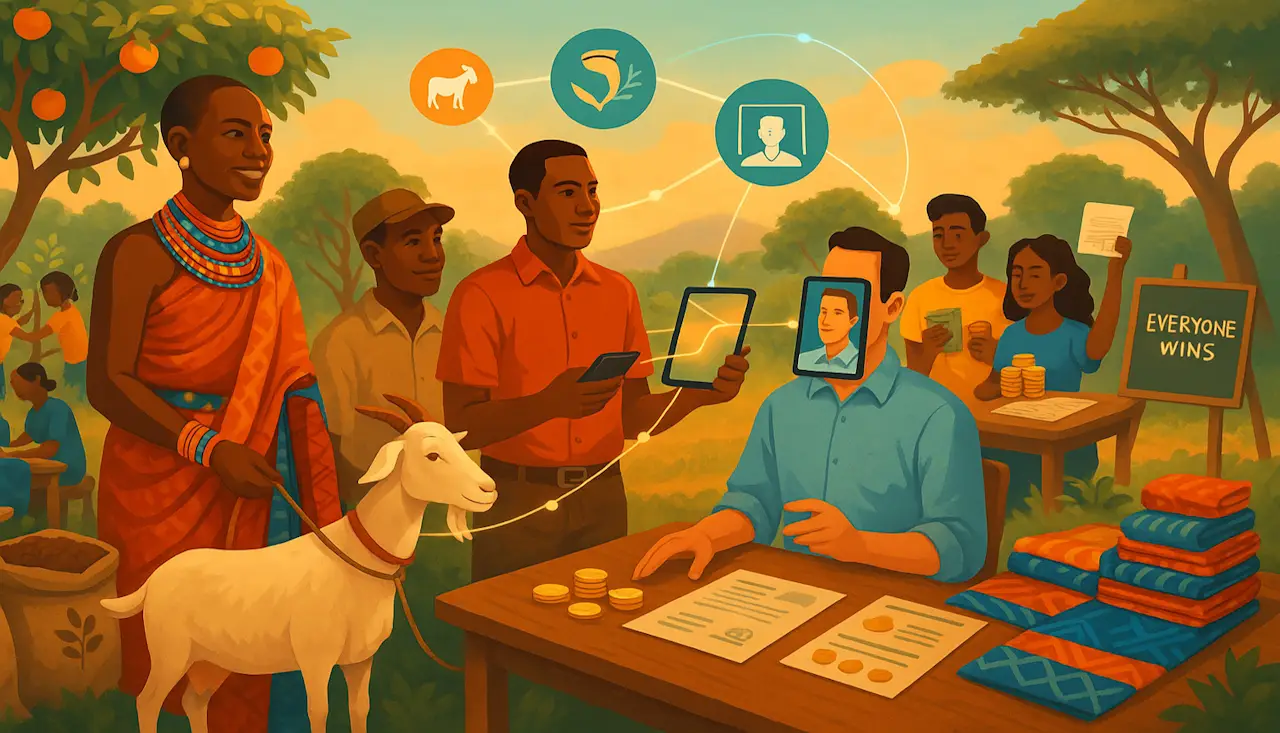
Many families across Africa face the same challenge: they have the skills and the will to work, but lack the means of production. A goat, a sewing machine, a bag of seeds, or a few fruit trees can make the difference between poverty and prosperity.
Maasai Investments is a simple, open-source initiative we created to solve this problem. The goal is to connect small entrepreneurs with local ambassadors and microinvestors. The process is quick, transparent, and easy to set up – and we’re making our methods publicly available so that you can start doing this in your own community right now.
What You Need
To start a Maasai Investments initiative, you need three roles:
- An Entrepreneur
Someone with the drive to work – herding animals, growing crops, or producing goods. They know their craft but need resources to begin. - An Ambassador
A trusted local contact with access to potential microinvestors. The ambassador explains the concept, gathers investments, and manages communication between investors and the entrepreneur. - Investors
People willing to contribute small amounts of money that directly convert into production means. For example:- A fruit tree for $5
- A goat for $35
- Seeds for $10
- Cloth for $25
How It Works
- Collect Investments
The ambassador reaches out to investors. Each contribution is linked directly to a production item (e.g., “you own this goat” or “you funded these seeds”). - Transfer Funds
Once the investment is pledged, the ambassador forwards the money to the entrepreneur, who uses it to acquire the agreed production means. - Produce and Sell
The entrepreneur uses the resource to generate income. This could be milk from goats, crops from seeds, fabric from cloth, or fruit from trees. - Profit Sharing
After deducting necessary expenses, profits are split fairly in three:- 1/3 for the investor (a return on their microinvestment)
- 1/3 for the ambassador (for managing the process)
- 1/3 for the entrepreneur (for their labor and risk)
Example: Investing in a Goat
- Initial cost: $35 (goat purchase)
- Additional costs:
- $2 in fees
- $6 in insurance
- $25 in feeding and care
- Total: $68
- Selling price after one year: $70
- Profit: $12
Split three ways:
- Investor: $4
- Ambassador: $4
- Entrepreneur: $4
Now imagine this scaled to 100 goats: each earns $400 – enough to provide a decent return for the investor, while giving a family steady income.
Tools We Provide
To make this easy, we’ve created ready-to-use resources:
- Spreadsheets for bookkeeping and profit tracking
- Prewritten contracts to formalize the agreement between parties
- Ownership certificates for investors
We are continuously improving these tools and are working on turning the system into a simple website for easier access.
How to Start Your Own Maasai Investment Circle
- Identify a motivated entrepreneur in your community.
- Find an ambassador who can connect with microinvestors.
- Use our spreadsheets, contracts, and templates to set up the structure.
- Start small: one goat, one tree, one piece of cloth.
- Track, report, and share results transparently with investors.
- Scale gradually as trust builds.
Why It Works
- Direct impact: Every dollar goes straight into production.
- Low risk: Investments are small, tied to real goods, and insured.
- Shared success: All parties benefit equally.
- Scalable: The system works whether you start with one goat or a hundred.
Final Thoughts
Maasai Investments is not a charity – it is a sustainable, local business model where everyone wins. Families gain the means to work, ambassadors earn for their coordination, and investors receive a fair return while making a real difference.
The methods are open-source. You can begin today.
👉 If you’d like access to our spreadsheets, templates, and resources, or if you want to share your own Maasai Investment success stories, reach out to us. Together, we can build a network of microinvestments that transforms lives.
Frequently Asked Questions
Maasai Investments connects small entrepreneurs with local ambassadors and microinvestors, providing families with the necessary resources to start small businesses. By funding essential items like goats, seeds, or sewing machines, families can generate income and improve their livelihoods.
To initiate a Maasai Investments circle, you need three key roles: an entrepreneur who requires resources, an ambassador who facilitates communication and gathers investments, and investors who contribute small amounts of money. Each role is essential for the smooth operation and success of the initiative.
In the Maasai Investments model, profits are divided equally among the three parties involved: one-third goes to the investor as a return on their microinvestment, one-third to the ambassador for managing the process, and one-third to the entrepreneur for their labor and risk. This fair profit-sharing structure encourages collaboration and sustainability.
Maasai Investments offers various tools to facilitate the process, including spreadsheets for bookkeeping, prewritten contracts to formalize agreements, and ownership certificates for investors. These resources are designed to simplify the setup and management of investments within the community.