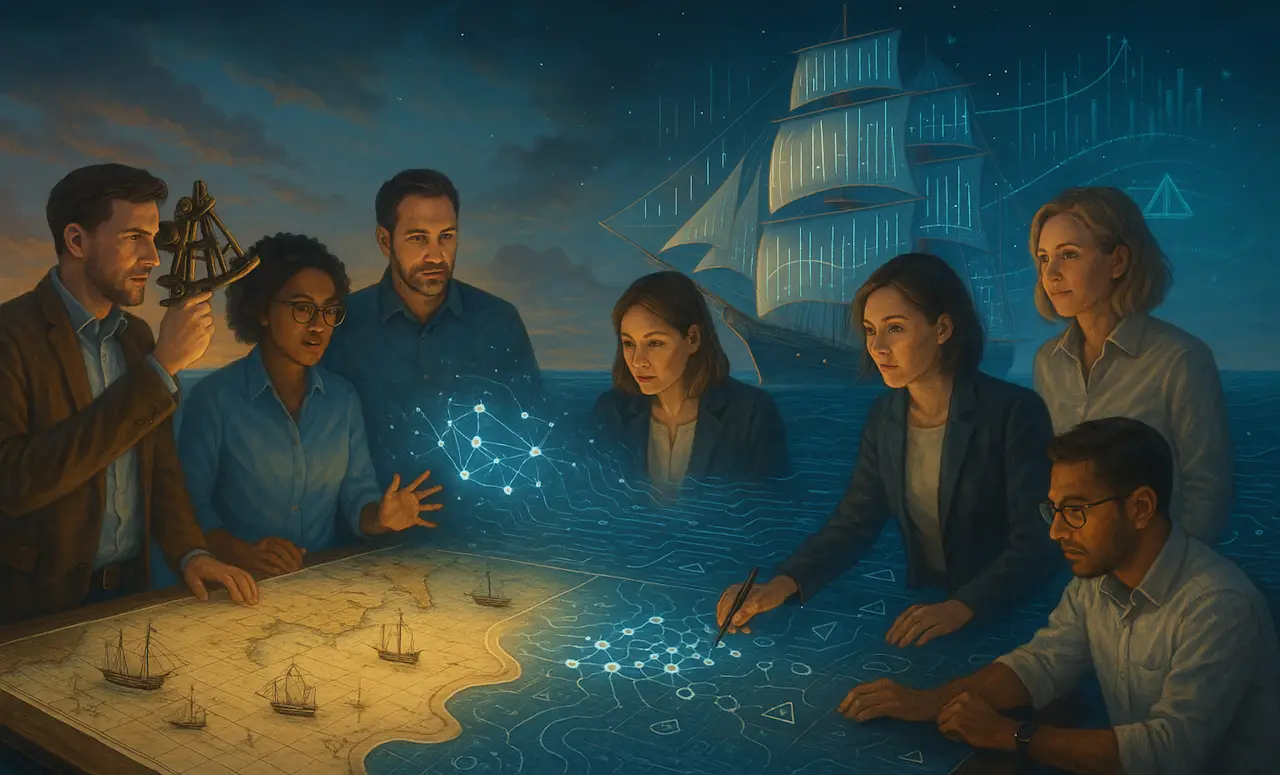
Why Navigating New Waters Isn’t Just Metaphor
Centuries ago, explorers sailed uncharted seas, trusting partially-drawn maps and quick wits. Today, AI specialists, prompt engineers, and risk auditors face their own unpredictable digital oceans. The tools and stakes have changed – yet the art of navigation stays eerily familiar.
Charting Unknowns: The Cartographer’s Discipline
For ancient sailors, maps were more promise than guarantee. Cartographers painstakingly recorded coastlines, hazards, and opportunities, bit by bit shaping the world’s collective knowledge. Modern AI specialists mirror this – meticulously building, testing, and updating data sets and models, aware every new project may reveal what they thought they knew was only half-true.
- Signal reading: Just as navigators read winds and stars, prompt engineers interpret outputs, searching for patterns (and dangers) beneath the surface.
- Iteration: Maps became more accurate with every voyage; in AI, every project sharpens the edge of what machines (and their makers) can do.
- Permanent vigilance: Risk auditors today stand where ship watchers once scanned horizons – always alert for shifting reefs and brewing storms, ethical or otherwise.
Sailing Together: Lessons in Collaboration and Correction
No sailor made discoveries alone. A successful voyage required a skilled crew – each person reading, doubting, and refining the collective course. The same applies now: diverse AI teams outperform lone geniuses, precisely because they share blind spots and challenge assumptions.
In both worlds, obsession with learning and humility is gold. Today’s data must be constantly re-mapped, just like old charts, because the landscape shifts fast. Clinging to old ‘knowns’ is deadly – whether you’re at sea or in a digital transformation.
The Real Lesson: Courage to Map as You Go
- Continuous improvement: Don’t just launch – iterate, document, and update. Success comes from relentless refinement, not luck.
- True collaboration: Trust your crew. Open forums, shared post-mortems, and even critical pushback make AI voyages safer and smarter.
- Embrace the unknown: The best explorers (and tech teams) don’t fear the blank edges of the map. They seek, pioneer, and sometimes admit: “We don’t know. Yet.”
Ready to become a digital navigator? Learn how to integrate AI in your business with real-world steps, and share your discoveries. In a world obsessed with certainty, the real advantage lies in the courage to keep re-drawing the map.
Frequently Asked Questions
AI specialists can learn the importance of meticulous mapping and continuous iteration from maritime navigation. Just as cartographers updated maps based on new discoveries, AI professionals must regularly refine their data sets and models to adapt to changing landscapes.
Collaboration is crucial in AI development because diverse teams bring different perspectives and challenge assumptions. Much like a skilled crew at sea, AI teams can navigate complexities more effectively by sharing insights, conducting open discussions, and learning from failures.
Embracing the unknown allows AI teams to explore uncharted areas and innovate without fear. Successful explorers and tech teams recognize that not all answers are known upfront, and they thrive by continuously seeking solutions and adapting as they go.
Continuous improvement is vital in AI projects as it fosters relentless refinement and adaptation. Rather than relying on initial success, teams should document their processes, iterate on their models, and remain vigilant to ensure their solutions remain effective and relevant over time.