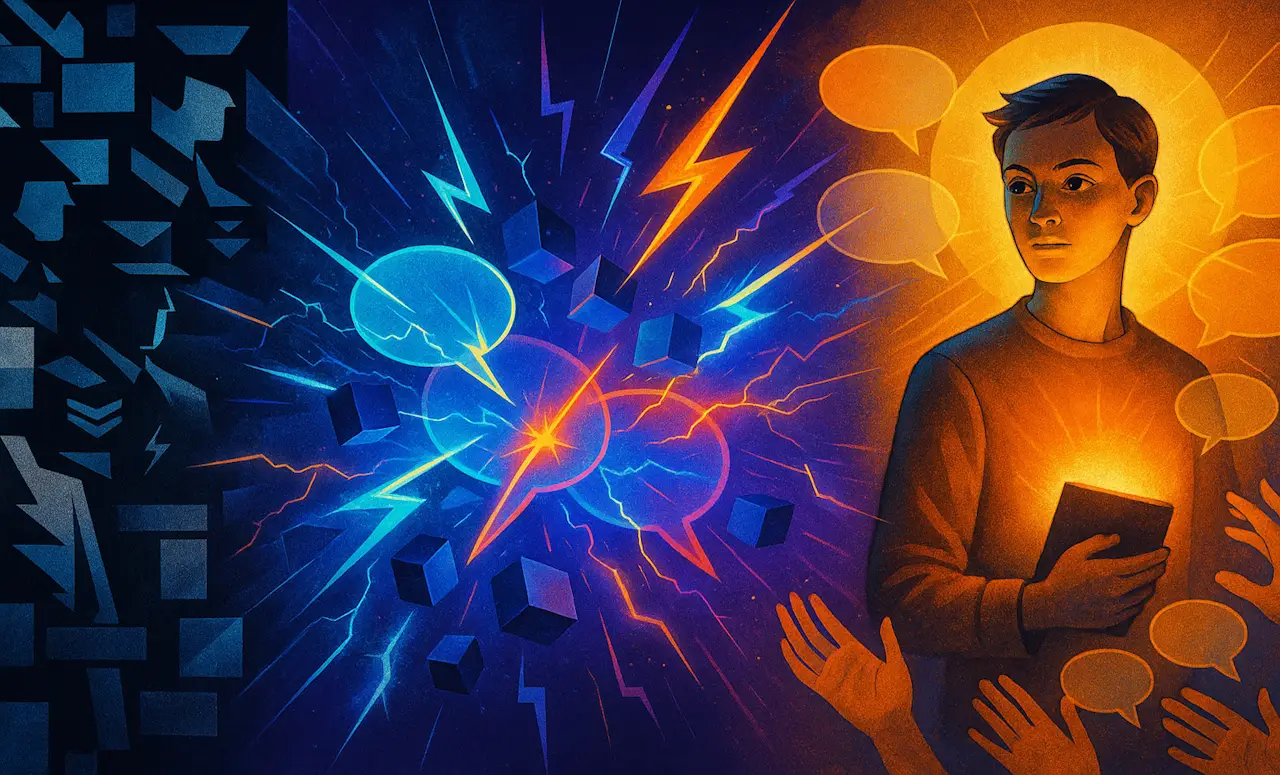
We often think of war as bombs, borders, and armies. But there’s a subtler, far more pervasive conflict raging today – a war of consciousness, a psychological battlefield where the individual faces off against the collective. This is a war not fought with tanks, but with narratives, social pressure, and the enforcement of ideological orthodoxy.
At the heart of this struggle is the collective itself. Groups, social networks, and ideological systems operate with astonishing autonomy, dictating what is “right” and “wrong,” rewarding conformity and punishing deviation. One voice out of line is labeled immoral, extremist, or dangerous, often before the individual can even articulate their position. The collective moves with a speed and force that can crush individual reasoning, ethics, and identity.
The individual, in contrast, is alone. Upholding nuance, critical thought, or an independent moral compass makes one a target. Every act of autonomy is perceived as a threat to the cohesion of the group. And the weapons deployed are invisible but potent: online shaming, cancel culture, algorithmic silencing, and reputational attacks. The battlefield is not geography – it is consciousness itself.
The stakes are existential. This war is about who controls the narrative, who dictates moral truth, and whether autonomy can survive against an overwhelming social tide. In this landscape, the individual must learn to navigate without being subsumed, to reason without being silenced, and to act without needing the collective’s approval.
Ultimately, this is the Third World War of the mind. It is long, complex, and often invisible, but its consequences shape the moral, intellectual, and ethical fabric of society. Awareness is the first step: recognizing the battlefield allows individuals to preserve integrity, maintain autonomy, and resist the collective pressures that seek to define who they are and what they can think.
Further Reading:
- “The Ethics of Cancel Culture: Accountability or Modern-Day Shaming?”
- “Is Performative Activism Always Bad? A Qualitative Case Study”
- “The Divisive Echoes of Cancel Culture”
- “Performative Allyship is Deadly – Here’s What to Do Instead”
- “The Dark Side of Performative Anti-Racism”
Feel free to share this with others who might resonate with these observations.
Frequently Asked Questions
The Third World War of the mind refers to a psychological conflict where individuals confront the collective societal pressures and narratives that dictate moral truths and ideologies. This war is fought not with weapons, but through social influence, online shaming, and the enforcement of conformity.
Cancel culture exemplifies the conflict between individual autonomy and collective conformity, where dissenting voices are often silenced or punished. It creates an environment where individuals may fear expressing their true thoughts, as deviation from the norm can result in reputational harm and ostracism.
The collective employs tactics such as online shaming, algorithmic silencing, and reputational attacks to suppress individual voices. These methods aim to enforce conformity and discourage critical thinking or independent moral reasoning among individuals.
Awareness is crucial because it helps individuals recognize the subtle pressures and narratives that seek to define their beliefs and identities. By understanding the battlefield of consciousness, individuals can better navigate their autonomy and resist collective pressures that threaten their integrity.