Abstract:
We propose a conceptual model in which our observable universe exists as a rule-based emergent simulation embedded within higher layers of reality. By examining the dependencies between layers, we argue for the necessity of a multi-tiered structure, wherein the base layer provides unchanging potential, the intermediary ruleset layer defines the constants and laws of physics, and the observable universe emerges from these constraints. This framework provides a coherent explanation for the apparent fine-tuning of physical constants, the emergence of dimensions, and the potential for recursive simulation.
1. Introduction
The hypothesis that our universe may be a simulation has been considered in multiple philosophical and scientific contexts. Traditional approaches often consider a single simulated layer; however, constraints on computation, consistency, and the manifestation of physical laws suggest the necessity of layered, recursive simulations. Here, we formalize this layered model and explore the implications for dimensionality, emergence, and the structure of reality.
2. Layered Simulation Structure
We define three essential layers:
- Host Layer (Base Reality):
- The unchanging substrate of existence.
- Provides the raw potential for structure and computation, but does not itself instantiate physical laws or entities.
- Conceptually, this layer may be represented as a one-dimensional or infinite-dimensional space of pure being.
- Ruleset Layer:
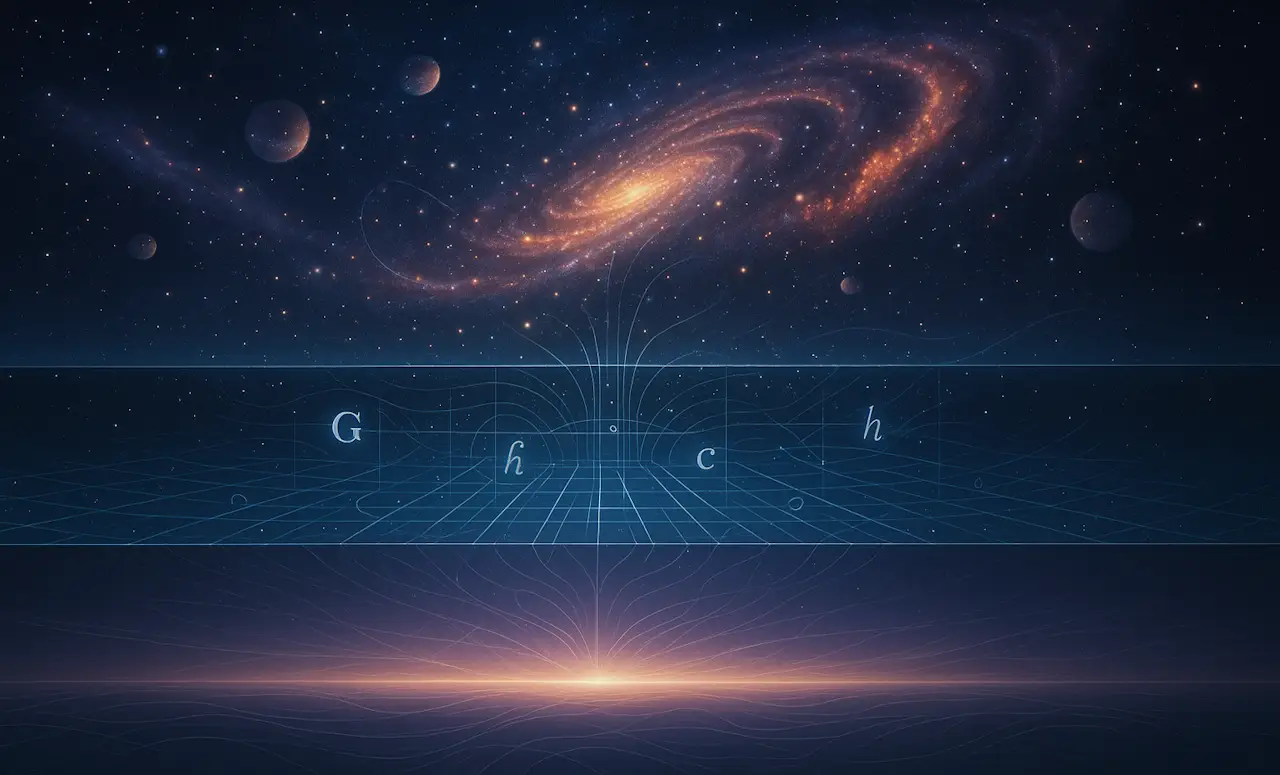
- Encodes the physical constants, laws, and meta-structure of the simulated universe.
- Emerges from the host layer’s potential without requiring change in the host.
- Functions as the interpreter, enabling consistent causality, dimensionality, and physics within the simulation.
- Example: constants such as GGG (gravitational), ccc (speed of light), and ℏ\hbarℏ (Planck constant) represent fingerprints of this layer in our observable universe.
- Simulation Layer (Observable Universe):
- The emergent universe instantiated according to the ruleset.
- Appears vast and complex, but its apparent size and richness arise from rule-based emergence, not direct resource allocation.
- Each layer can, in principle, simulate additional universes using the same rule-based emergent principles.
3. Dimensionality and Emergence
- Dimensionality: Each successive layer introduces additional informational or causal dimensions. The base layer may be one-dimensional (existence/non-existence) or infinite-dimensional (all possibilities). The ruleset layer adds structure and order, enabling the emergent multi-dimensional universe we observe.
- Emergence: The ruleset layer emerges from the host layer not through dynamic change but as a relational instantiation. Patterns encoded in the ruleset are realized within the host’s potential, enabling the unfolding of phenomena in the simulated universe.
4. Recursive Simulation Potential
- Rule-Based Emergence: Because simulations are instantiated via rules rather than brute-force replication of all states, it is possible for a universe to simulate a larger universe conceptually.
- Finite Recursion: Despite conceptual infinity, physical and computational constraints imply a limit to recursive simulation. Each higher layer contains fewer resources relative to the universe it simulates, necessitating a host layer as a final unchanging substrate.
5. Implications
- Fine-Tuning: The necessity of a ruleset layer provides a natural explanation for the apparent fine-tuning of physical constants, as these constants are expressions of the interpreter layer, not arbitrary emergent features.
- Perceived Reality vs. Actual Substrate: Higher layers are compressed relative to lower layers, meaning apparent richness in a simulation does not equate to substrate size.
- Potential for Multiversal Expansion: Rule-based emergence allows for universes within universes, each potentially “larger” in emergent complexity than the physical resources of its host.
6. Conclusion
This layered, recursive simulation model provides a coherent framework for understanding the structure of reality, the emergence of physical laws, and the apparent dimensionality of the universe. By positing a host layer of unchanging potential, a ruleset layer encoding universal constants, and an emergent simulation layer, we reconcile the apparent vastness and fine-tuning of our universe with a logically consistent structure.
References:
- Bostrom, N. “Are You Living in a Computer Simulation?” Philosophical Quarterly, 2003.
- Tegmark, M. Our Mathematical Universe, 2014.
- Lloyd, S. Programming the Universe, 2006.
- Deutsch, D. The Fabric of Reality, 1997.
Frequently Asked Questions
The three layers are the Host Layer, which serves as the unchanging substrate of existence; the Ruleset Layer, which encodes the physical laws and constants; and the Simulation Layer, which represents the observable universe emerging from the ruleset.
The model suggests that the Ruleset Layer, which defines the constants and laws of physics, emerges from the Host Layer’s potential. This structured approach allows for the apparent fine-tuning of physical constants as properties of the simulation rather than random occurrences.
Dimensionality increases with each successive layer, with the Host Layer potentially being one-dimensional or infinite-dimensional. The Ruleset Layer adds structure, enabling the emergence of the multi-dimensional universe we experience.
Rule-based emergence refers to the process by which the Simulation Layer unfolds from the Ruleset Layer, driven by encoded patterns rather than exhaustive replication of all states. This allows for the creation of complex phenomena in the observable universe while conserving computational resources.